In an ever-changing and competitive landscape, organisations need to stay agile, responsive, and consistently able to deliver on their strategic objectives. That does not happen by chance. It requires a systematic approach to strategic delivery, underpinned by robust performance management and risk management—working as a single, connected system rather than as separate “management disciplines”.
From setting clear organisational goals, to defining in-year deliverables, to aligning team activity, the importance of these elements cannot be overstated. When they are designed to work together through an agile, hierarchical management approach, they enable the realisation of strategic objectives whilst maintaining a deliberate balance between operational delivery (keeping services and capabilities running) and change delivery (improving outcomes, capability, resilience, or efficiency). Strong governance and assurance provide senior stakeholders with a clear picture of progress, confidence, success measures, and delivery risk.
In this blog we will:
- define and position Key Performance Indicators (KPIs) and SMART objectives, and explain why both matter;
- explain the practical processes of strategic delivery, performance management, and risk management; and
- show how each role and process interacts so the organisation can steer, learn, and adapt.
We will also touch on public sector realities—complex stakeholder landscapes, political cycles, transparency expectations, and outcome-led measurement. Finally, we will describe how a maturity model can act as a roadmap, helping organisations understand current capability, identify gaps, and progress towards Level 5 (“continuous improvement”), where learning and improvement become routine.
Across all sections, a key theme remains: shifting priorities and external influences are normal. The system needs to detect change early, make explicit trade-offs, and respond with pace—without losing control.
Aligning Risk Management, Performance Management & Strategic Delivery
At the intersection of strategic achievement and operational efficiency is a tight coupling between performance management, risk management, and the delivery of strategic operational and change goals. In a volatile environment, organisations that can measure what matters, manage what threatens value, and mobilise delivery at pace are far more likely to realise intended benefits and protect return on investment (ROI)—whether that “return” is financial value, public value, improved outcomes, or increased resilience.
Performance management is a continuous, dynamic process: planning, monitoring, reviewing, learning, and adjusting activity to achieve strategic objectives. It spans individual performance, team performance, and portfolio performance. By leveraging KPIs and SMART objectives, it provides a structured method for focusing effort on what matters most, demonstrating progress, and creating a shared understanding of “good”. Importantly, it also creates a repeatable feedback loop—so that leadership decisions are based on evidence rather than optimism.
Risk management is a proactive discipline that identifies, assesses, and manages threats and opportunities that could influence objectives. In strategic delivery terms, risk management is both a shield and a lighthouse: it protects the organisation from avoidable harm and helps it navigate uncertainty, especially where change is disruptive and dependencies are complex. It enables informed decisions on trade-offs (time, cost, scope, quality, benefits) before problems become crises.
Operational goals (deliverables) are short- to medium-term targets set in pursuit of long-term strategic objectives—service quality, cost control, resilience, capability availability, compliance, and customer or citizen experience. Strategic change initiatives relate to broader transformations intended to improve competitive position, strengthen capability, respond to external change, or deliver better outcomes.
The achievement of operational and change goals ties directly into benefits realisation—the process of identifying, planning, managing, and evaluating intended benefits of initiatives or investments. Benefits realisation ensures delivery is not just “busy”, but valuable: outputs lead to outcomes, and outcomes lead to measurable benefit. It also makes value explicit, so prioritisation becomes a structured conversation rather than a political one.
ROI, in turn, is a performance measure used to evaluate investment efficiency and compare options. In commercial organisations, ROI is commonly expressed financially; in the public sector it is often framed as improved outcomes, capability uplift, better availability, reduced risk exposure, or increased resilience—supported by transparent, evidence-based reporting.
In this matrix, performance management and risk management are not parallel activities; they are mutually reinforcing. Performance management clarifies goals and measures progress; risk management clarifies uncertainty and confidence. Together they enable better prioritisation, faster course correction, and a more reliable path to benefits realisation—strengthening the organisation’s strategic positioning and long-term success.
Establishing clear organisational goals, in-year deliverables, and team-aligned activities
The strategic direction of an organisation is shaped by the alignment of organisational goals, in-year deliverables, and team activity. This alignment—echoing the hierarchical nature of most organisations—enables effective target setting against the organisational vision, reinforces disciplined priority management, and leverages continuous feedback, governance, and reporting to refine priorities, re-calibrate objectives, and (where needed) evolve the vision.
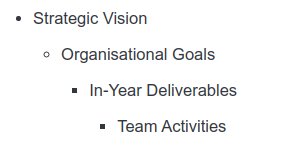
Organisational goals and vision
Clear organisational goals start at the top: board, executive committee, or parent organisation. They establish the vision—what the organisation aspires to become—and the outcomes it is accountable for. That vision becomes the foundation for strategic goals that guide investment, operating models, delivery portfolios, and service priorities. The value of a hierarchical cascade is simple: it keeps senior intent connected to day-to-day work, reducing drift and duplication.
Stakeholders at this stage often include senior leaders, shareholders, regulators, and (in the public sector) political leadership, spending authorities, and central bodies supporting policy and delivery. Wider representation—citizens, service users, industry partners, or delivery ecosystem stakeholders—may also be relevant depending on the mission and operating model.
Their combined inputs help ensure goals reflect both stakeholder expectations and external dynamics.
In-year deliverables
From strategic goals come in-year deliverables: concrete objectives to be achieved within the planning cycle. Senior Responsible Owners (SROs), portfolio leads, and delivery owners translate strategic goals into deliverables that can be resourced, governed, tracked, and assured.
A crucial step is agreeing priority. Resources are finite, and not everything can be “top priority”. Leaders must be explicit about sequencing, trade-offs, and minimum viable scope. In practice, a prioritised set of deliverables also makes risk reporting more meaningful: delivery teams can surface risks early and propose options that align with the organisation’s real choices.
Defining deliverables should include a clear view of:
- intended benefits and success criteria;
- key dependencies (internal and external);
- resourcing assumptions and constraints; and
- governance touchpoints and assurance needs.
Team-aligned activities
In-year deliverables are then decomposed into team activity, mapped to capability and capacity. Each team should understand how its work contributes to deliverables, and how deliverables contribute to strategic goals. This creates coherence: work is not just a list of tasks, but a chain of contribution.
SMART objectives at activity level give clarity for teams and create reliable performance and risk assessment. The stronger the prioritisation—from goals, to deliverables, to activities—the easier it is for teams to make practical decisions in delivery, including where to pause, pivot, or escalate.
Continuous feedback, governance, and reporting
The linchpin of the model is a robust system of feedback, governance, and reporting:
- Teams report progress, constraints, risks, and confidence against SMART objectives.
- Deliverable owners review performance and risk to steer outcomes.
- Leadership receives aggregated insight on progress, benefits confidence, resourcing health, and material risk exposure.
Governance structures should align to the delivery structure and the organisation’s assurance framework, so decisions and actions remain connected to goals. Regular reporting creates transparency and enables leaders to see what is truly happening—not just what is planned.
This feedback loop also supports agility. In fast-changing contexts, the organisation must adapt based on evidence and external change (market conditions, regulation, political priorities, technology shifts, environmental factors, or emergent operational risks). When goals, deliverables, performance data, and risk insight are joined up, adaptation becomes controlled rather than chaotic.
Through careful orchestration of goals, in-year deliverables, and team activity, organisations can create a coherent system of strategic execution—clear, prioritised, and adaptive—capable of making demonstrable progress towards the vision.
Agile organisational agenda setting and refinement process
An agile agenda-setting and refinement process cascades from senior leadership to teams, increasing in specificity and “SMARTness” at each level. It is inherently iterative, with an established cadence for two-way feedback between levels. This is not bureaucracy for its own sake; it is how the organisation stays aligned as reality changes.
Typically, the process begins at the start of a planning cycle with organisational goals, then progressively refines these into deliverables and team objectives. Deliverables (in-year activity supporting goals) should have clear resources and ownership so delivery units can align work, report progress with confidence, and surface risk early.
Process flow
- Organisational goals setting: Board/executive sets broad goals aligned to the vision and defines success criteria.
- In-year deliverables definition: SROs/delivery owners define deliverables aligned to goals (using KPIs) and secure required resources.
- Team activity planning: Deliverables are decomposed into team activities, each with SMART objectives and clear measures.
- Performance monitoring and reporting: Teams track progress, resource usage, risks, and confidence against objectives.
- Feedback and refinement: Senior leadership reviews performance and risk insight (progress, confidence, benefits, ROI/value, exposure) and adjusts priorities or approach.
- Iterative recalibration: The cycle repeats at a practical cadence (often monthly/quarterly), informed by delivery reality and external change.
An example of this process is captured in the following table:
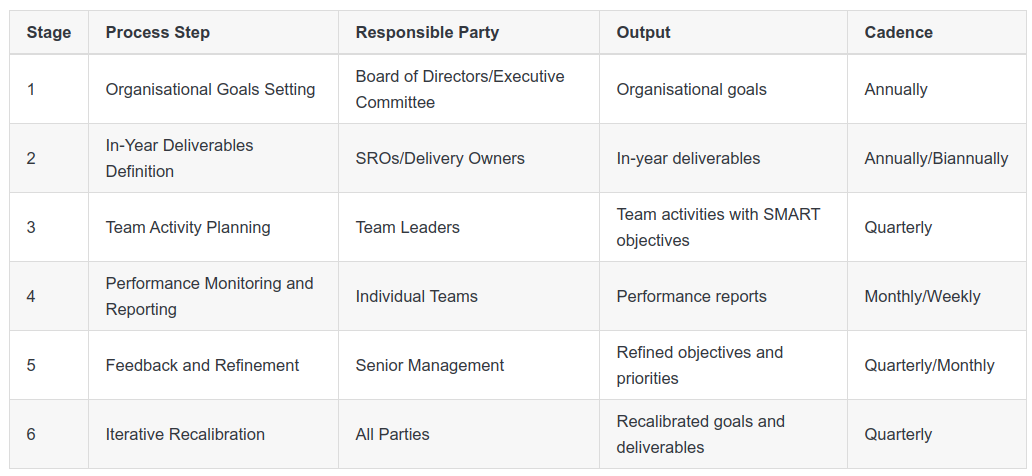
By using a cascading, iterative process, organisations can keep activity aligned to strategy whilst preserving the ability to respond to change. It also promotes accountability, transparency, and shared understanding of responsibilities across the organisation.
Accountability, responsibility and supporting roles
In hierarchical delivery, the roles of accountability, responsibility, and support differ in scope and shift as you move through levels.
- Accountability: Ownership and ultimate obligation for outcomes. The accountable person is answerable for success or failure. There should be one clear accountable owner per objective/deliverable.
- Responsibility: Duty to carry out tasks or deliver components. Multiple people/teams can be responsible across different aspects.
- Support: Provision of enabling inputs—expertise, resources, data, assurance, tooling—so responsible parties can deliver effectively.
How the roles typically map:
- Strategic vision: Board/executive is accountable for vision and strategic direction; supported by strategy, finance, policy, and enabling functions.
- Organisational goals: Senior leadership accountable for outcomes; responsible parties develop strategies and delivery plans; support provided by enabling and assurance teams.
- In-year deliverables: SROs/portfolio leads accountable; delivery teams responsible; support from PMO, finance, procurement, architecture, risk, comms, HR, commercial partners, etc.
- Team activities: Team leaders accountable for execution; team members responsible for delivery; support from shared services and specialist functions.
Accountability cannot be delegated, but responsibility and support can be distributed. Clarity at each objective, deliverable, and activity level reduces ambiguity, improves pace of decision-making, and strengthens delivery confidence.
Clear role definitions
Clear accountability, responsibility, and support are foundational for effective strategic delivery. They matter because they provide:
- Direction and ownership: reduced duplication and fewer gaps; everyone knows what “good” looks like and who owns it.
- Efficiency and productivity: less friction, fewer escalations caused by unclear decision rights, and better focus.
- Stronger risk management: easier to identify where risk sits, who must act, and how to learn from issues.
- Better communication and collaboration: teams know who to engage for decisions, approvals, and specialist input.
- Faster decision-making: reduced delays and improved organisational responsiveness.
- Motivation and job satisfaction: clearer expectations and clearer connection between work and organisational outcomes.
Across the hierarchy—from vision to activities—clear roles support transparency, ownership, and continuous improvement, and help build a delivery culture that can operate effectively under uncertainty.
Performance management in hierarchical delivery governance
Performance management is a systematic process that plans, monitors, reviews, learns, and improves performance at individual, team, and organisational levels to achieve strategic goals. Within hierarchical delivery governance, performance management provides critical inputs at each stage and acts as a stabilising feedback mechanism across both operational and change delivery.
In practice, it ensures:
- measures are meaningful and aligned to outcomes;
- performance conversations focus on learning, not blame;
- leaders can prioritise based on evidence; and
- delivery confidence is visible, not assumed.
Here’s a table outlining how performance management interlinks with each stage of the delivery process:
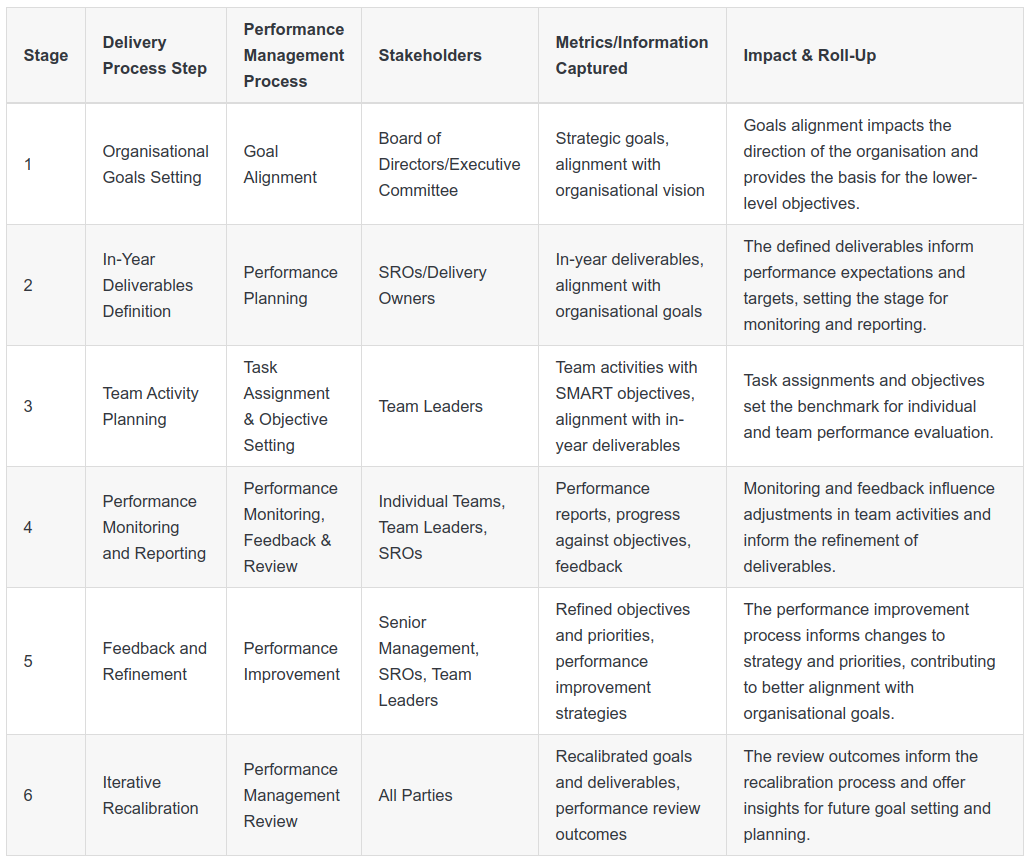
Performance management keeps focus on results and value (including ROI/public value), and supports agility through a reliable feedback loop. When aligned with governance, it helps strategic intent permeate all levels, enabling coherent delivery of services and capabilities.
Performance management in public sector organisations
Performance management principles remain consistent, but public sector implementation brings distinctive considerations. The focus shifts from profit to public value, outcomes, and stewardship of public money, often with higher scrutiny and more complex stakeholder environments.
- Public value and societal needs: measures often reflect service quality, accessibility, availability, capability uplift, safety, equality impacts, and citizen experience—not just cost.
- Accountability and transparency: reporting and assurance expectations are typically stronger, with more open scrutiny and governance.
- Political considerations: strategy can shift due to changes in ministerial priorities, legislation, or wider policy direction—demanding adaptability.
- Resource constraints: “do more with less” pressures increase the importance of prioritisation, benefits clarity, and efficiency evidence.
Our table below illustrates how these considerations can affect each stage of performance management:
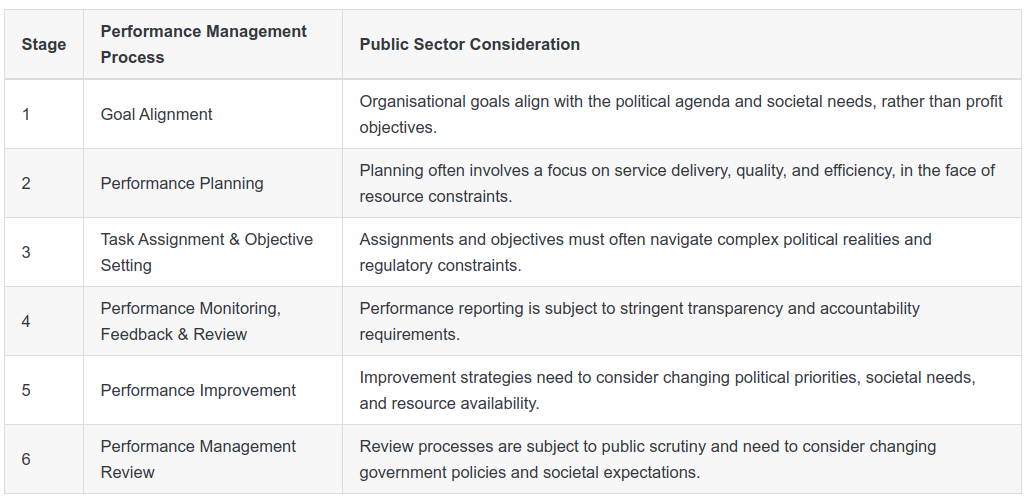
Tailoring performance management to the mission and stakeholder landscape is essential. The aim is to measure what matters, report with integrity, and steer delivery towards outcomes that citizens actually experience.
Risk management in strategic delivery governance
Risk management is a proactive process that identifies, assesses, and prioritises uncertainties that could impact objectives. In hierarchical strategic delivery, risk management integrates with each stage so threats and opportunities are surfaced early, managed deliberately, and used to inform decisions on investment, sequencing, and delivery approach.
Integration with the strategic delivery process
Risk management should not be a periodic “risk register exercise”. Done well, it is a continuous discipline embedded in planning, delivery, governance, and learning—supporting resilience and better decision-making.
Our table below outlines how risk management integrates with each stage of the strategic delivery process:
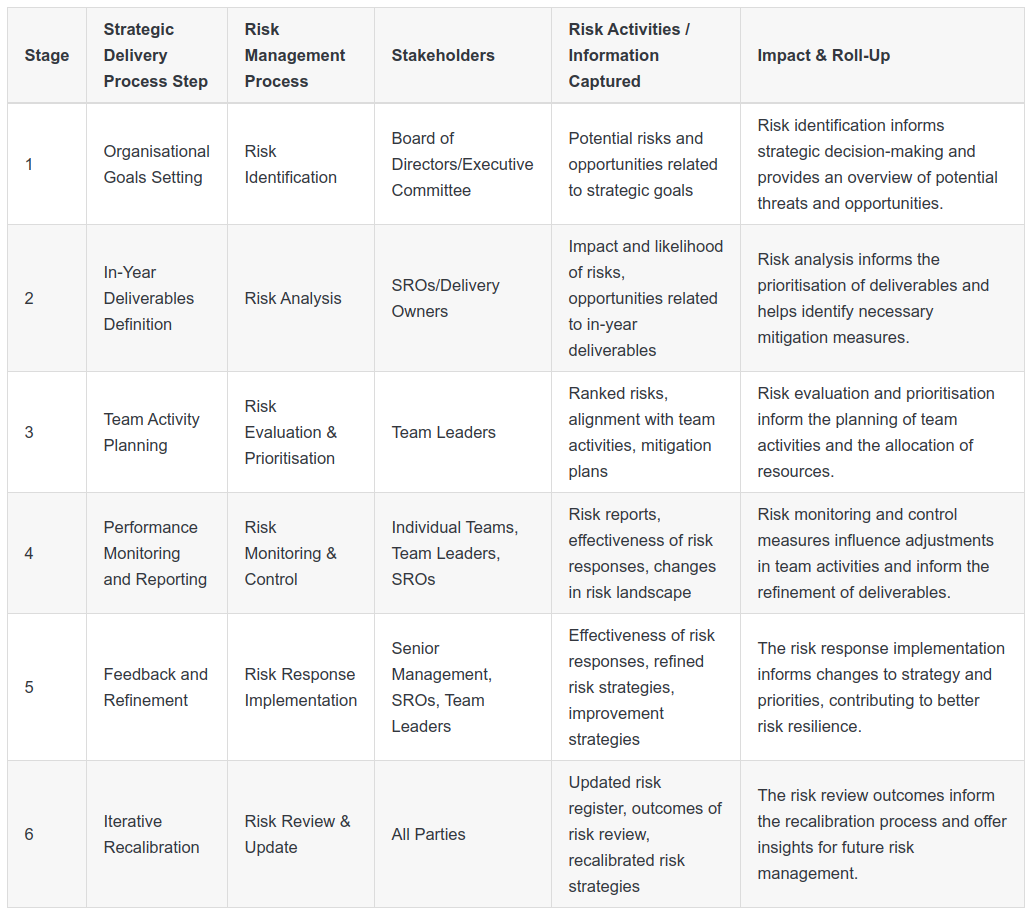
Risk management enables organisations to take informed decisions and act with confidence, establishing a culture that anticipates and responds to change. By integrating risk into governance, organisations improve alignment with goals, enhance delivery performance, and strengthen resilience across both operational and change activity.
Ensuring your risk processes align to your standards
It is important that risk management processes align closely with organisational standards and existing governance, risk, and compliance (GRC) frameworks. In particular, many UK organisations align to globally recognised standards and established government guidance such as ISO 31000, Management of Risk (M_o_R), and HM Treasury’s Orange Book.
- ISO 31000 (Risk management — Guidelines): supports principles and a structured process for identifying, analysing, evaluating, treating, monitoring, and communicating risk—integrated with decision-making. ([ISO][1])
- Management of Risk (M_o_R): provides a structured approach designed to be applied at strategic, programme, project, and operational levels, emphasising embedding and review so risk management becomes “how we manage”, not an add-on. ([uat2.axelos.com][2])
- HM Treasury Orange Book (Management of Risk): provides UK government guidance on embedding risk management in governance, leadership, and decision-making, and is intended to be used alongside other guidance (for example on appraisal and evaluation). ([GOV.UK][3])
Aligning your process to your chosen framework is not about compliance theatre; it is about consistency, comparability, and enabling risk insight to flow across portfolios and services—supporting better decisions, stronger resilience, and improved delivery confidence.
Bringing it all together: strategic delivery, performance and risk management
In a hierarchical strategic delivery process, performance management and risk management are not isolated activities. They are integral components that work together at each stage to plan, execute, monitor, learn, and refine delivery—making benefits and value more reliable, and surprises less frequent (or less damaging).
Phased approach
Below is how the three processes reinforce one another across the delivery cycle:
- Organisational goals setting: leadership sets vision, strategic goals, and success criteria. Risks to those goals are identified; performance measures are shaped to reflect what matters.
- In-year deliverables definition: deliverable owners define annual deliverables contributing to goals; risks and dependencies are assessed; performance targets and benefits measures are set.
- Team activity planning: teams define SMART activities; risks are evaluated and prioritised; capacity and capability constraints are made explicit.
- Performance monitoring and reporting: progress is tracked; risk exposure and confidence are updated; reporting supports fast decision-making.
- Feedback and refinement: insights inform adjustments to objectives, sequencing, and resourcing; risk responses and performance improvements are implemented.
- Iterative recalibration: outcomes from review cycles inform updates to goals/deliverables, preserving alignment with the vision and responding to change.
A summary of how delivery, risk and performance integrate at each stage:
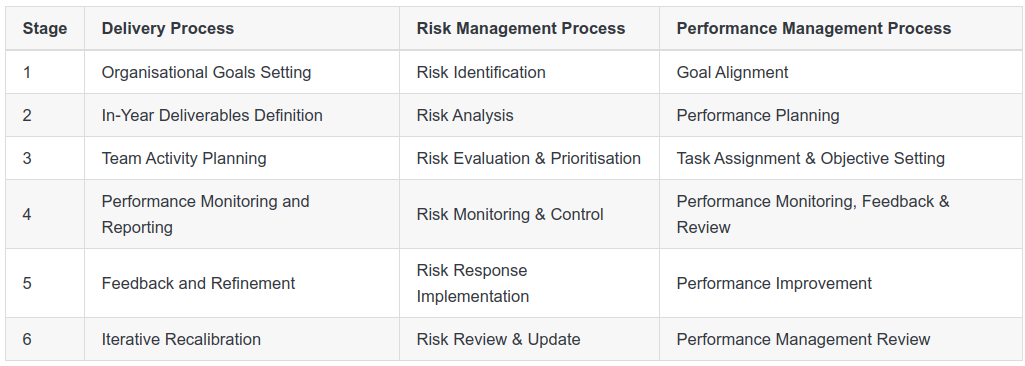
An integrated, structured approach allows organisations to plan and execute effectively whilst navigating uncertainty and adapting quickly—leading to improved performance, stronger resilience, and more reliable achievement of strategic goals.
The maturity model
A maturity model provides a structured approach to assess and improve capability. It helps organisations understand current strengths, identify gaps, and progress towards higher levels of effectiveness and efficiency. Using Capability Maturity Model Integration (CMMI) maturity levels (1–5) as a pattern, organisations can build a maturity model spanning strategic delivery, performance management, and risk management—then use it to benchmark and drive improvement.
-
Creating the maturity model
Identify key dimensions for each component (strategic delivery, performance management, risk management). Evaluate each dimension on a five-level scale: Initial, Managed, Defined, Quantitatively Managed, and Optimising.
-
Validating the model
Validate through self-assessment, peer review, internal assurance, or third-party assessment. The goal is a realistic baseline, not an aspirational score.
-
Using the model
Use results to prioritise improvement actions, build delivery roadmaps, and reassess periodically. Treat it as a living tool that evolves as the organisation learns.
An example combined maturity model might look like:
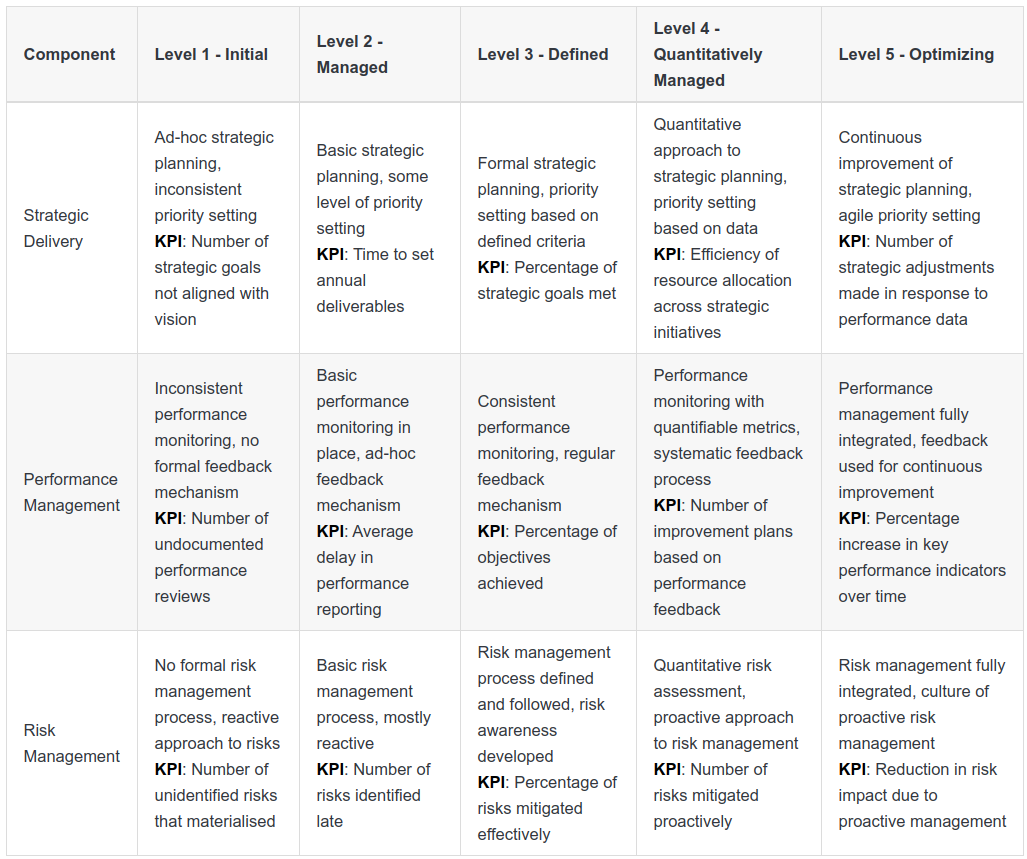
These KPIs and maturity statements should be customised to your context, objectives, and constraints. The goal is to create measurable indicators that track progression and build a sustainable “continuous improvement” capability—where learning is embedded in governance, not dependent on individuals.
Agile responses to shifts in priorities and external influences
Organisations operate in dynamic environments where change is constant. External events, internal learning, emerging risks, and shifting stakeholder needs can all change priorities and even reshape strategic goals. Performance and risk management are crucial for detecting these changes early and enabling controlled, evidence-based responses.
Activity-level changes
At activity level, change may arise due to resource shifts, delivery issues, supplier disruption, technology constraints, or re-prioritisation. Risk management identifies threats and opportunities, and supports practical response choices (mitigate, avoid, transfer, accept, exploit). Performance management provides real-time progress and variance insight, enabling quick corrective action and preventing small issues becoming big failures.
In-year deliverable changes
Deliverable-level shifts usually involve re-sequencing, re-scoping, or pausing work. Triggers include policy change, market change, operational incidents, regulatory developments, or learning that original assumptions were incorrect. Risk management clarifies implications and dependencies; performance management supports rapid re-baselining of targets and measures so reporting remains honest and useful.
Vision and goal changes
Changes to vision or strategic goals are typically driven by significant shifts—major regulatory change, restructuring, new leadership direction, economic shocks, or large-scale events affecting society or markets. Risk management evaluates strategic exposure and supports scenario thinking; performance management redefines success measures and ensures delivery remains aligned to the new direction.
The key across all scenarios is agility without loss of control: ongoing reassessment, explicit trade-offs, and an iterative cycle of setting objectives, monitoring performance, managing risks, and refining strategy. When embedded well, this cycle drives learning, improves resilience, and increases delivery confidence.
Conclusion
A structured and agile approach to strategic delivery—coupled with effective performance and risk management—is pivotal for any large organisation striving to fulfil its vision in a changing environment. Understanding the framework is the first step; applying it is where value is created.
Start by examining your current strategic delivery, performance management, and risk management processes. Use a maturity model to understand where you are across key attributes and dimensions, and to identify the most valuable improvements.
Then develop clear, SMART improvement plans aligned to your maturity goals. Make resourcing and sequencing explicit. Establish measures that demonstrate progress and maintain transparency—especially where trade-offs are unavoidable.
Finally, remember: this is a framework, not a rigid structure. It must remain adaptable to your organisational context, constraints, and operating environment. Embrace continuous improvement, keep feedback loops active, and do not be afraid to re-calibrate your models and governance when evidence tells you things have changed.
In the end, the aim is an agile, responsive, and resilient capability that not only survives uncertainty but can thrive within it—delivering outcomes, value, and confidence over time.
References (validated and updated)
- Project Management Institute (PMI). A Guide to the Project Management Body of Knowledge (PMBOK® Guide) – Seventh Edition (and The Standard for Project Management). ([Project Management Institute][4])
- Kaplan, R. S., & Norton, D. P. The Balanced Scorecard: Translating Strategy into Action. Harvard Business School Press. ([Harvard Business School][5])
- COSO. Enterprise Risk Management—Integrating with Strategy and Performance. ([COSO][6])
- Doran, G. T. “There’s a S.M.A.R.T. way to write management’s goals and objectives.” Management Review.
- ISO. ISO 31000: Risk management — Guidelines (and UK adoption as BS ISO 31000). ([ISO][1])
- HM Treasury. The Orange Book: Management of Risk – Principles and Concepts (current version). ([GOV.UK][3])
- Project Management Institute (PMI). The Standard for Program Management – Fifth Edition. ([Project Management Institute][7])
- ISACA / CMMI Institute. CMMI Model Content (V3.0 release information and content changes). ([cmmiinstitute.com][8])
- Peters, T. The Little BIG Things: 163 Ways to Pursue Excellence. HarperCollins.
- Rumelt, R. Good Strategy/Bad Strategy: The Difference and Why It Matters. Profile Books.
- Schwaber, K., & Sutherland, J. The Scrum Guide (current official version). ([scrumguides.org][9])
- Sull, D., & Eisenhardt, K. M. Simple Rules: How to Thrive in a Complex World. Houghton Mifflin Harcourt.